
Plants at Work
Most of us know a co-worker who enjoys decorating their workspace with plants and flowers - perhaps you are that person yourself. Many workers, especially those of us who work in office environments, may enjoy the presence of plants and flowers. There are innumerable studies that validate the positive impact of nature views and nature access during work - particularly when it comes to stress recovery. These studies have validated that nature views through windows, and even images and sounds of nature, contribute to these positive results. So how about plants in the workplace? Can a curated officescape of potted plants, trees in an atrium, or flowers on table tops produce similar positive results?

Modern Workplace Design
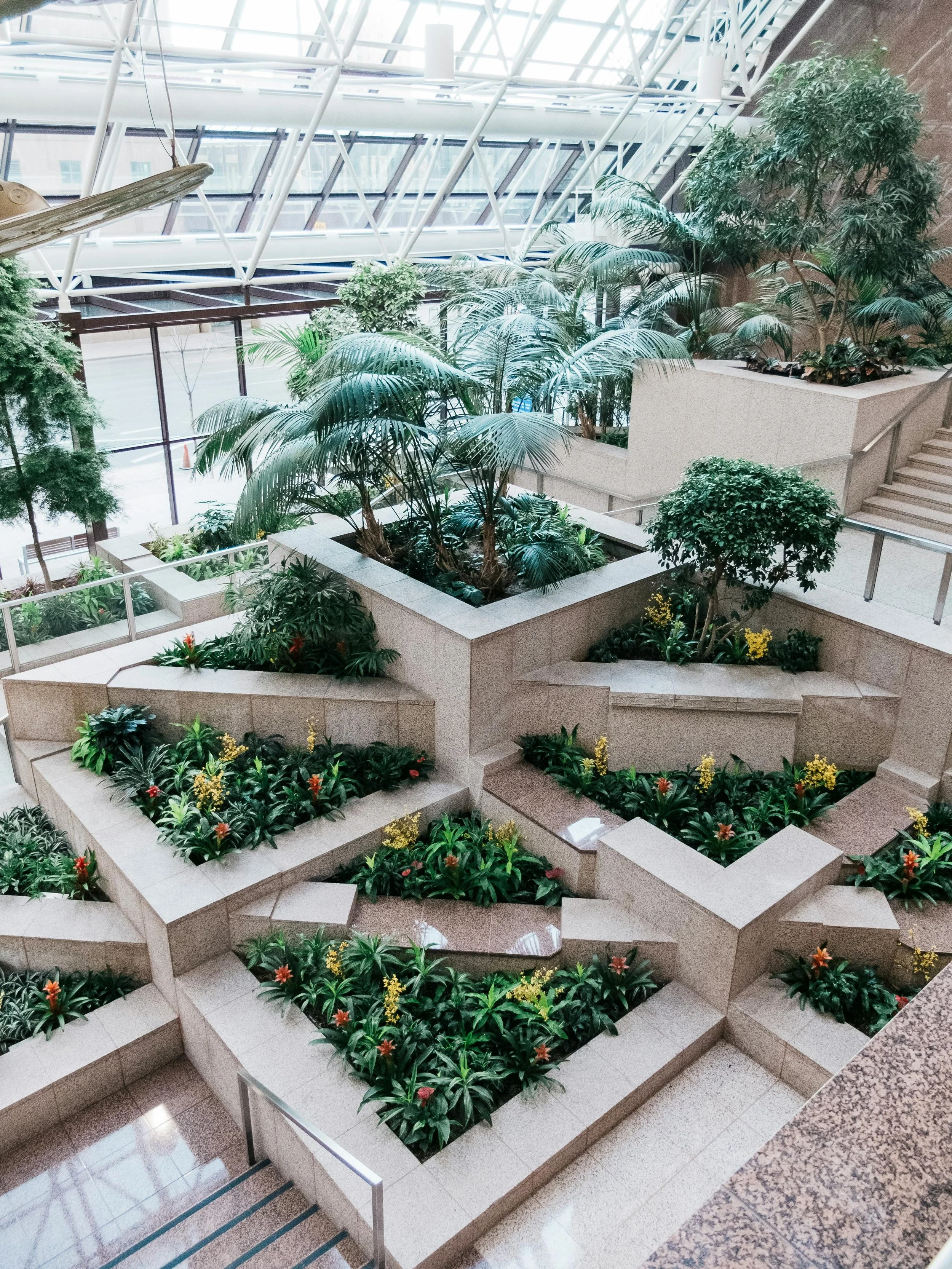
A lot of the modern workplaces - particularly office buildings - have accepted that physical work conditions impact workers in a number of important ways, like worker satisfaction, productivity, communication, and absenteeism. The concept that paying attention to worker wellbeing can help enhance overall job performance and work product has been around since the 1980s, and in subsequent years we begin to see workplace innovations like the open floor plans designed to enhance communication and camaraderie. Plants as decor - sometimes called office landscaping, including large atrium gardens - has been a notable element in these efforts. Businesses generally believe that the presence of plants produces positive effects in key performance areas. But even with the rise of positive attitudes toward office landscaping, businesses have not validated those assumptions with any scientific evidence.
Researching Plants at Work
So what have the researchers found?
First, it’s important to reiterate that a workplace is a very complex environment, encompassing many elements that impact how we think and feel when we’re there: of course there’s the job itself, as well as things like access to privacy, interpersonal relationships, autonomy over decision-making, management styles, gender identities/dynamics, our ability to move around, and more. Given this complexity, it’s hard for researchers to isolate how any one environmental factor impacts employee satisfaction and performance.
Not dissimilar to studies on the impact of nature exposure, many of the studies designed specifically to investigate the impact of office plants involve self-reported participant data using validated survey methods that measure various aspects of the worker experience like job satisfaction, life satisfaction, nature of work, coworker relationships, desire to quit, and concentration. These surveys are often distributed across various workplaces in several cities and many of them look not only at office plants but other office environment factors like windows and access to green space.

One such survey was conducted across about 600 office workers in Texas and the mid-west, primarily looking at workers under 4 base conditions:
No plants/no windows
Plants/no windows
No plants/windows
Plants/windows
Workers with plants and windows reported the highest overall job satisfaction and the highest percentage of those workers reported high levels of contentment in their life overall. They also reported the highest scores on overall positivity with the nature of their work, their supervisors, and their interpersonal relationships with coworkers. Workers with plants and no windows were the second highest in these indicators, while workers without plants scored the lowest on all of these regardless of whether they had windows.
Other studies of workplace plants integrate the worker survey more directly into the work environment by providing pre-and-post surveys in simulated work environments within a lab setting. One study took the lab experiments to the next level by utilizing an actual office environment as the site for the pre-and-post testing; the 11-storey office building of a computer system company in Virginia. In this experiment, the researchers first removed all the plants from the 9th and 11th floors of the building, and distributed surveys to workers to collect worker experiences after working for 3 months without any office plants. In that first survey, the researchers found no significant differences between the attitudes of workers on either floor: all of them reported liking their jobs and their office environment.
In the next phase of the experiment, the researchers added plants to the 11th floor using a professional plantscaping company: installing things like three desk-or-floor sized plants for private offices, planters, and desk-or-floor sized plants for the open areas. The 9th floor received only photographic artwork. The researchers waited 6 months while workers worked in these environments and then administered the survey again. 2 weeks later, the 9th floor was professionally plantscaped, and the third survey was distributed 3 months after that. After tabulating the results of all 3 surveys, the researchers were not able to find any evidence that the presence of plants influenced worker behavior, attitudes, or work satisfaction: all of these measures remained steady across all three phases of the experiment.
Workers in the study did report favorable attitudes toward the plants; they said the plants made the office a more desirable place to work and they perceived an improvement in the air quality and their sense of relaxation. These attitudes are aligned with a study conducted with university students in Missouri, finding that most people attach meaning to the presence of plants and flowers within a workspace, positively impacting perceptions of the person whose office is decorated with horticultural elements in dimensions like caring, relaxation, professionalism, health, femininity, organization, stability, and creativity. Conversely, most people had a negative view of the presence of fake plants and flowers and/or plants that were dying; extending that negative view to the person within that office space.
Results like these suggest that while people do genuinely have a positive attitude toward plants in the workplace, the plants don’t necessarily contribute to behavioral changes or objective benefits like productivity, communication, or concentration.
Another challenge in testing the singular impact of plants in the workplace on work outcomes is that it’s fairly difficult to measure something as multidimensional as productivity. One U.S. university study sought to do this by using a computer program to test reaction time as a proxy for productivity. They placed participants in a windowless computer lab with no wall decor, controlling only the presence of plants. Participants’ stress level, blood pressure, and emotional states were all measured before and after engaging with the computer program, which presented them with a series of shapes that they identified by pushing corresponding buttons on the keyboard. The results: there were no significant differences found in the blood pressure or stress measures for those exposed to plants versus those who were not, though the researchers did note that all participants experienced a rise in blood pressure during the computer test, and that rise was smaller for those whose computer lab was decorated with plants. The presence of plants did not impact the number of errors participants made in the computer test, but they did find that the response time of those in the presence of plants was 12% faster than those without; the study concluded, therefore, that the presence of plants in a workspace may positively impact productivity.
Health Care Work Spaces
As we’ve discussed, there are many factors that impact employee experiences at work, but what about work spaces that are directly experienced by clients as well, like a hospital or a hotel? One 1992 study concluded that the use of interior plants in hospitality settings boosts occupancy rates and increases profit, and many studies of healthcare settings have confirmed that things like architectural features (room size and layout), ambient features (lighting and smells), and design features (color, artwork, plants) impact the wellbeing of patients in those spaces. One such study in the Netherlands sought to isolate whether the presence of plants in hospital rooms impact patients’ perceptions of the space and their stress levels. Participants who had or will be hospitalized for chronic pain were shown images of either a hospital room with plants or without. Participants who saw the hospital room with indoor plants perceived less stress than participants who saw the hospital room with no plants. Further, the study showed that the hospital rooms with plants were perceived to be more attractive, and that attractiveness led to further reduction of stress.
Future Studies
The existing empirical studies on the impact of plants in the workplace seem to show that while workers generally have positive attitudes toward plants in their space and like to have them around, there’s currently no consistent scientific evidence to verify that the presence of the plants is contributing to employee behavior, work satisfaction, or attitudes overall. Still, it seems clear that office landscaping and company gardens continue to be popular, so what more could companies do to further the research in this area? A company with a large indoor garden in its atrium could do things like begin to track what types of activities people do in the space and compare those to similar activities done in other places in the building: is there a difference between the attitudes and productivity of workers in both spaces? Who is avoiding the use of that space and why? What impression does the space have on visitors who spend time in the interior garden versus those who don’t? Are there differences in experience between those who spend time in the garden versus those who merely view it from their office window?
Practical Applications
So what are some of the tangible takeaways from these studies on plants in the workplace?
Idea #1
Plenty of evidence validates that people like having plants at work, so businesses can at the very least contribute to their employees’ sense of comfort in a space by adding and maintaining plants (being careful to consider allergens and bugs).
Idea #2
The presence of plants in your workplace impacts people’s perceptions of you, in both positive and negative ways, so if you choose to decorate with plants or flowers, make sure to have a plan to actively maintain them.
Idea #3
Our experience in our workspace is an amalgam of many factors. If you feel particularly stressed at work and/or if your work area doesn’t have sunlight exposure and/or window views, adding plants to your immediate area may be a small way to begin to tip the scales toward a more positive overall experience.
Idea #4
The experience of the work place is particularly important and far-reaching in health care work places, where both employees and clients spend a lot of time and are often stressed. Health care facilities in particular should integrate plants into their decor as a means of increasing the perceived attractiveness of the space and related lowering of patient stress.
Sources
Aitken, J.E. and R.D. Palmer. 1989. The use of plant to promote warmth and caring in a business environment. Amer. Cult. Assn. 11th Annu. Meeting, St. Louis.
Cordoza et al (2018). Impact of nurses taking daily work breaks in a hospital garden on burnout. American Journal of Critical Care, 27 (6), 509-512.
Dravigne, A., T. Waliczek, R. Lineberger, and J. Zajicek. 2008. “The Effect of Live Plants and Window Views of Green Spaces on Employee Perceptions of Job Satisfaction.” HortScience 41 (1): 183–87.
Dijkstra, K., M. E. Pieterse, and A. Pruyn. 2008. “Stress-reducing Effects of Indoor Plants in the Built Healthcare Environment: The Mediating Role of Perceived Attractiveness.” Preventive Medicine 47 (3): 279–83.
Laviana, J.E. 1985. Assessing the impact of plants in the simulated office environment: A human factors approach. PhD Diss., Kansas State Univ., Manhattan.
Lohr, V.I. , Pearson-Mims, C.H. & Goodwin, G.K. 1996 Interior plants may improve worker productivity and reduce stress in a windowless environment J. Environ. Hort. 14 97 100
Lottrup L, Grahn P, Stigsdotter UK. Workplace greenery and perceived level of stress: benefits of access to a green outdoor environment at the workplace. Landsc Urban Plan. 2013; 110:5-11.
Shoemaker, C.A. , Randall, K. , Relf, P.D. & Geller, E.S. 1992 Relationships between plants, behavior, and attitudes in an office environment HortTechnology 2 205 206
Zadik, M. 1994 Studying the corporate garden 275 282 Flagler J. & Poincelot R. People–plant relationships: Setting research priorities Haworth Press New York
