
The Nature Pyramid
How Much Nature Do We Need?
Most of us are familiar with the generally accepted recommendations designed to optimize our physical health; things like getting at least 10,000 steps per day, keeping our calorie intake to around the low 2000s, and exercising at least 30 minutes per day. If you’re like me, these general recommendations for “doses” of healthy activities help me plan my time and sometimes become fun little benchmarks for me to hit; “oh, I’m behind on my water consumption - better fill my bottle!”
It has been well-documented by many empirical studies that time spent in nature can have positive effects on things like our well-being, mental health, physical health, and a sense connectedness to others In particular, nature has been shown to help us restore our brains after long periods of work. What these studies have not yet been able to pinpoint in any exact way are recommendations for the amount or type of nature exposure - what we might call the “doses of nature”- that allow us to perform at our best.
Difficult to Measure
Why not? Well, research on the benefits of time spent in nature is still relatively new compared to studies on things like physical exercise, and there are lots of factors that make the identification of an exact recommendation pretty tricky. Firstly, most of the studies on the benefits of time in nature are based on self-reported data from participants using empirically proven ratings scales; it’s still pretty cumbersome for researchers to do things like take saliva samples and measure blood pressure consistently as participants traipse through the forest. That means that results from studies that test the restorativeness of nature create room for questions about whether there might be other factors contributing other than just the nature itself.
For example, one study of people in Southern England asked participants to self-report how much time they spent in the garden beside their house. They then correlated that with their self-reported physical and mental health. Participants who spent more time in their garden showed lower levels of depression, while those who spent less time in their garden showed higher levels of depression. The problem here is that depression in this case could be either a cause or an effect of nature exposure: it may be that due to depression, people don’t go outside as much, and/or because they don’t go outside as much, they have higher levels of depression.
Additionally, the decision to spend time in nature and how nature makes us feel is in many ways intensely personal; our attitudes toward nature are shaped by things like our culture, socio-economic status, physiology, knowledge, and personal preferences. All of these factors have made it difficult for researchers to universally recommend specific nature doses. Several studies have illuminated some great starting points, and researchers generally like the concept of using the dose-response method to begin to move in that direction.
Towards a Recommendation
The dose-response method is used in health sciences to analyze the effect of a dose of a substance or activity on a health response known to have a causal relationship. In the nature exposure context, scientists are generally interested in testing three important aspects of dose-response:
Intensity: the quality and quantity of the natural environment
Frequency: the number of nature exposures in a set time frame
Duration: the time in which someone is exposed could be measured in minutes all the way up to years, depending on what outcome one is studying (this is the most common measure)
In her book, The Nature Fix, Florence Williams interviewed several Finnish scientists, who recommend spending 5 hours per month in nature in order to rejuvenate. Their research has indicated that just 15 minutes outside contributes to uplifted emotions, and the more time people spent in green spaces, the better they felt. This finding is consistent with an Italian study that showed improvement in cognitive function after less than ten minutes of viewing photographs of natural settings, and a study in Japan on forest bathing revealed decreased heart rate within minutes of exposure to natural forest environments. Another study in the U.K., which surveyed people as to their activities in proximity to nature over the past week, zeroed in on 120 minutes per week as the minimum point at which health and restoration benefits are most manifest.
Most studies done using the dose-response method, for nature exposure or otherwise, usually produce results in which there is a gradual or rapid increase in the benefit of the dosage, and then the effects level off or even decrease after a certain threshold is met. This seems to be true in several of the nature exposure studies, especially around stress recovery: walking through a forest has been shown to reduce stress, but if the forest at any point becomes too dense, it can actually stop being restorative and end up causing stress.
The Nature Pyramid
So how can we make sense of all these numbers, some of which measure duration, some measure frequency, and all are subject in some way to the intensity of the nature experience? Enter the Nature Pyramid.
The Nature Pyramid is a concept created by Tanya Denckla-Cobb and further developed by Tim Beatley to provide a visual guide to help us begin to build for ourselves a personalized way to think about what dosage of nature will help us perform at our personal best.
Similar to the concept of the food pyramid, the pyramid shape indicates that activities at the base of the pyramid are happening in greater frequency but perhaps for shorter duration and intensity, and those at the top less frequently, but probably for a greater duration and greater immersion.
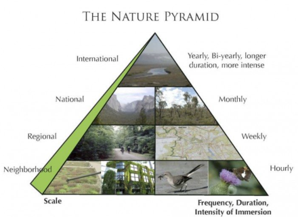
Image from:
Beatley, Tim. (2012, August 7). Exploring the Nature Pyramid. The Nature of Cities. https://www.thenatureofcities.com/2012/08/07/exploring-the-nature-pyramid/
Base of the Pyramid: here we’re looking at daily doses of nearby nature, like strolling tree-lined streets on our way to work, sitting by a window taking in a sunset, or listening to birds.
Tier 2 of the Pyramid: these weekly doses of nature may require us to travel outside of our immediate neighborhood, but perhaps still within or close to our own city; like going to a bigger city park; not something we could necessarily do every day because we’d generally spend more time there. For me, I’ve got a lot of trees in my neighborhood, but if I want to visit an actual park, I need to drive about 15 minutes away to a metro park, so I don’t do it every day, but it’s easy to do on the weekend.
Tier 3 of the Pyramid: monthly doses of nature are locations that are perhaps further still - like a state park. For example, I live in land-locked southeastern Michigan, so for me, a monthly visit to a coastal city like Ludington or Traverse City would be something I might do for a weekend away once per month.
Tier 4 of the Pyramid: once per year we could be heading to an area far from your norm; for me, living in Michigan this might look like a trip to Grant Teton National Park where I’ll be able to see mountains and animals that I don’t see in my regular life, and since I had to travel so far to get there, I’m probably spending a lot of time immersed in this area - doing multiple hikes, or even camping.
From a conservation perspective, it should be noted that the higher up we go on the pyramid, the more likely it is that we’re spending money and producing some form of waste or pollution to get to the nature experience, so the Nature Pyramid can help us make personal choices based on our personal views of sustainability and waste.
The Nature Pyramid is not prescriptive: it in fact invites more questions than it provides answers about nature dosages, so that’s why it’s useful to think of it as a framework we can use to build our personal nature exposure plan based on our own preferences and needs.
Tips for Using the Nature Pyramid
As an individual or team activity, try downloading this blank version of the Nature Pyramid to begin building your own personalized plan for getting your nearby, intermediate, and exotic doses of nature throughout the year ahead. These activities can range from sitting quietly reading a book on your porch to taking your daily jog on a forest path to pulling weeds in the community garden.
Sources
Beatley, Tim. (2012, August 7). Exploring the Nature Pyramid. The Nature of Cities. https://www.thenatureofcities.com/2012/08/07/exploring-the-nature-pyramid/
Cox, D. T. et al. Doses of nearby nature simultaneously associated with multiple health benefits. Int J Environ Res Pub He 14, 172 (2017).
Shanahan, D.F.; Fuller, R.A.; Bush, R.; Lin, B.B.; Gaston, K.J. The health benefits of urban nature: How much do we need? BioScience 2015, 65, 476–485.
White, M. P., Alcock, I., Grellier, J., Wheeler, B. W., Hartig, T., Warber, S. L., et al. (2019). Spending at least 120 minutes a week in nature is associated with good health and wellbeing. Sci. Rep. 9, 1–11. doi: 10.1038/ s41598-019-44097-3
Williams, Florence. (2017). The Nature Fix. W.W. Norton & Company.
